
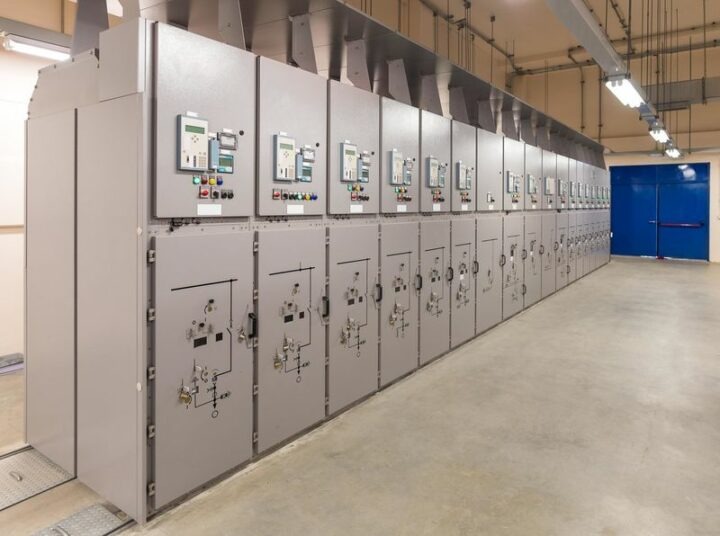
Medium voltage modular switchgear cells are medium voltage switching equipment used in indoor or outdoor environments such as transformer substations connected to distribution networks up to 36 kV, industrial facility distribution centers, and step-down or step-up switchyards. They include functions such as switching, protection, and measurement.
Modular cells contain many electrical components used in distribution networks, including protection relays, current and voltage transformers, circuit breakers, disconnectors, cable connection points, and busbars. They ensure safe access for personnel while maintaining system safety.
They have a compact structure, require low maintenance, and offer easy and reliable operation. They are classified as air-insulated or gas-insulated systems.
In SF6 gas-insulated metal-enclosed switchgear, the active live parts inside the cell are insulated with SF6 gas. These types are known as compact RMU (Ring Main Unit) systems.
Air and Gas Insulated Types
In air-insulated metal-enclosed switchgear, the busbars are insulated by air, while disconnectors and circuit breakers are placed inside an SF6 gas-insulated tank. Energy switching operations are performed within the SF6 environment, while busbars remain air-insulated.
Depending on design and application, modular cells may include:
- Busbars
- Disconnectors
- Load break switches
- Earthing switches
- Circuit breakers
- Protection relays
- Cable bushings
- Voltage indicators
- Surge arresters
- MV fuses
- Current and voltage transformers
- Lighting equipment
- Low voltage compartments
Cells are also classified based on internal compartment structure, internal arc classification, and service continuity level.
Internal Arc Classification
- A: Accessible only by authorized personnel
- F: Accessible from front side
- L: Accessible from lateral sides
- R: Accessible from rear side
Service Continuity Classification
- LSC-1: All components are in a single compartment; intervention requires full shutdown
- LSC-2A: Maintenance possible on switching compartment while busbars remain energized
- LSC-2B: Maintenance possible even with busbars and cable compartments energized
Technical Characteristics
In Turkey, standard medium voltage cells are typically rated at:
- 36 kV nominal voltage
- 630 A rated current
- 16 kA short-circuit breaking capacity
These cells usually comply with PI compartmentalization, AFL internal arc classification, and LSC-2A service continuity standards.
The physical size of the cell increases with voltage level due to required air insulation distances. For example, at 36 kV, approximately 35–36 cm spacing is required between busbars to prevent flashover.
Gas-insulated systems allow significantly smaller dimensions due to higher dielectric strength of SF6 gas compared to air, making them suitable for space-limited installations.
Protection and Applications
Modular medium voltage cells are widely used in:
- Transformer substations
- Industrial facilities
- Power plants
- Renewable energy systems
- Urban distribution networks
- Commercial buildings
Common cell types include:
- Incoming/outgoing load break switch cells
- Fused transformer protection cells
- Circuit breaker feeder cells
- Coupling cells
- Measurement cells (current & voltage)
- Cable connection cells
Each cell type serves a specific function in the distribution system and ensures safe and controlled energy management.
Standards
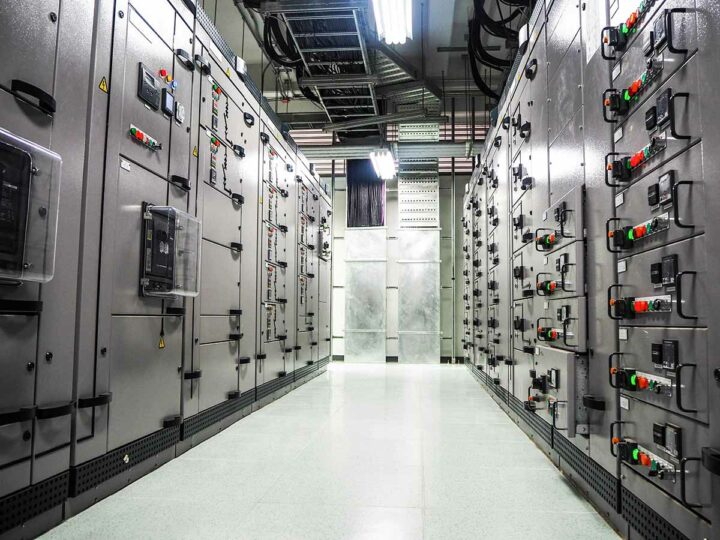
SF6 gas-insulated modular cells used up to 36 kV must comply with relevant technical standards such as TEDAŞ specifications for metal-enclosed SF6 switchgear systems. Air-insulated systems must comply with corresponding TEDAŞ technical specifications for medium voltage switchgear.