
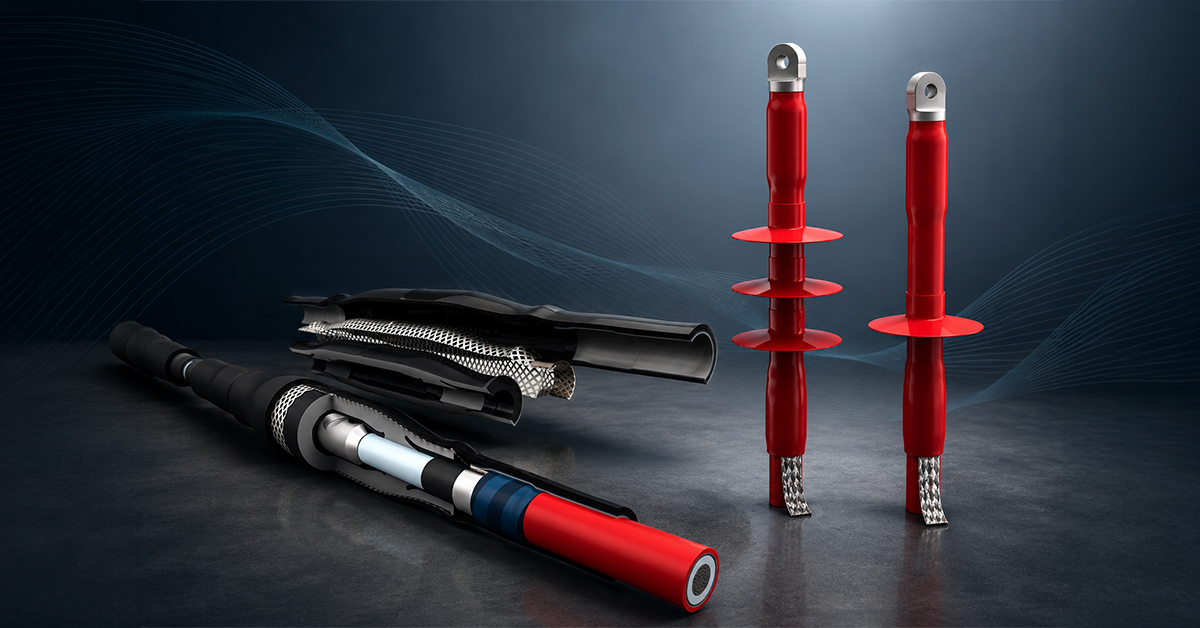

How to Select the Right Cable Accessories for Medium Voltage Systems
In any energy project, medium voltage power cables are undoubtedly one of the major investment items. However, the long-term reliability and operational continuity of the system often depend on components that represent a much smaller share of the total project cost: cable accessories.
Terminations, joints and connectors play a critical role in maintaining the electrical integrity of a medium voltage network. Incorrect product selection or improper installation can lead to insulation failure, partial discharge, overheating, moisture ingress and ultimately unplanned outages.
So, from substations and industrial facilities to renewable energy plants and distribution networks, what should you consider when selecting medium voltage cable accessories?
Choosing the Right Cable Termination: Indoor, Outdoor or Separable?
The first step is to clearly define where the cable will be terminated. Installation conditions and environmental exposure directly influence the type of termination required.
- Indoor Terminations
Indoor terminations are designed for protected environments such as switchgear rooms, substations, transformer rooms and enclosed electrical equipment.
Since they are not directly exposed to rain, UV radiation or severe atmospheric conditions, their design focuses primarily on electrical insulation, stress control and reliable connection to the equipment.
- Outdoor Terminations
Outdoor terminations are used in exposed environments such as overhead structures, outdoor substations and open switchyards.
Their shed design helps prevent the formation of a continuous conductive path caused by rain and surface contamination, reducing the risk of tracking. They are also designed to withstand UV radiation and demanding environmental conditions.
- Separable / Plug-in Terminations
Separable connectors are widely used in compact switchgear, RMUs, transformers and other modern medium voltage equipment. Depending on the interface, they are commonly available in Type L (Interface B) and Type T (Interface C) configurations.
Their fully insulated and screened design provides a high level of touch safety while their compact construction makes them particularly suitable for installations where space is limited.
2. Installation Technology: Heat-Shrink or Cold-Shrink?
Two of the most widely used technologies in medium voltage cable joints and terminations are heat-shrink and cold-shrink.The right choice depends on factors such as installation conditions, available tools, workmanship, project requirements and overall lifecycle considerations.
Heat-Shrink Accessories
Heat-shrink accessories use specially formulated materials that are heated and shrunk onto the cable using a controlled heat source.
Advantages:
- Long shelf life
- Robust construction
- Cost-effective solution
- Suitable for a wide range of medium voltage applications
Important consideration:
Installation quality is highly dependent on correct heating technique. Uneven heating or excessive heat can negatively affect the material and the overall performance of the accessory.
In environments where open flames are restricted, such as certain petrochemical or hazardous areas, the use of a gas torch may also present additional safety considerations.
Cold-Shrink Accessories
Cold-shrink accessories are manufactured using pre-expanded silicone or EPDM rubber. During installation, the internal support core is removed, allowing the accessory to contract and form a tight seal around the cable.
Advantages:
- No heat or open flame required
- Fast and convenient installation
- More consistent installation performance
- Excellent flexibility and adaptation to cable thermal expansion and contraction
- Particularly suitable for applications where installation conditions are challenging
Important consideration:
Cold-shrink accessories generally have a higher initial purchase cost and may have more specific storage and shelf-life requirements than heat-shrink products.
3. Understanding the Cable Construction
Knowing only the voltage level — for example, “I need a 36 kV joint” — is not enough to select the correct accessory. Before ordering, at least three key cable parameters should be clearly defined.
Conductor Material: Copper or Aluminium?
The conductor material affects the selection of the connector or lug.
Using an unsuitable connector for the conductor material can lead to connection problems, increased contact resistance and potential long-term reliability issues.
For applications involving both copper and aluminium conductors, bimetallic and mechanically bolted connector solutions can provide greater flexibility and simplify installation.
Cable Cross-Section
Cable accessories are normally designed for specific conductor cross-section ranges, such as 95–240 mm² or similar configurations. The exact conductor size should always be confirmed before selecting the accessory to ensure proper mechanical and electrical compatibility. Range-taking mechanical connectors can also provide a significant logistical advantage by covering a wider range of conductor sizes with fewer product variants.
Number of Cores
The cable construction must also be considered. Accessories for single-core cables are different from those designed for three-core cables, which may require additional components such as breakout boots or three-way sealing arrangements.
4. Electrical Stress Control and International Standards
One of the most critical areas in a medium voltage cable accessory is the point where the cable insulation and screen are removed. At this transition, the electrical field can become highly concentrated. This is why the quality and design of the electrical stress control system inside a termination or joint are essential for long-term reliability.
When selecting a medium voltage cable accessory, it is important to verify that the product has been properly type-tested according to the relevant international standards.
For medium voltage accessories, key references include IEC 60502-4 and CENELEC HD 629.1 S3, depending on the voltage level, cable construction and application. IEC 60502-4:2023 specifies type-test requirements for accessories used with power cables from 6 kV up to 30 kV (Um = 36 kV), while HD 629.1 S3 covers accessories for extruded-insulation cables up to 20.8/36 kV (42 kV).
Beyond simply checking whether a product “complies with a standard”, it is important to review the relevant type test reports, test conditions, voltage class and cable configurations covered by the testing.
A product should be selected based on the actual requirements of the project rather than simply its nominal voltage rating.
Choosing the Right Cable Accessory with Vekmar Engineering
The right medium voltage cable accessory is not simply a component added to a cable system. It is an essential part of the system’s electrical and mechanical integrity.
Correct selection can help:
- Improve system reliability
- Reduce the risk of unplanned outages
- Ensure long-term electrical performance
- Simplify installation
- Improve field safety
- Increase the overall service life of the cable system
At Vekmar, we provide a comprehensive range of medium voltage cable accessories for XLPE-insulated copper and aluminium power cables.
Our portfolio includes heat-shrink and cold-shrink terminations and joints, indoor and outdoor terminations, L and T-type separable connectors, and mechanical connectors designed for a wide range of conductor cross-sections.
With our product range, technical expertise and engineering support, we help customers identify the right accessory configuration for their cable system and application.
Need help selecting the right medium voltage cable accessory for your project?
Contact our engineering team through our Contact Us page or explore our technical catalogues to find the right solution for your application.